


A plethora of lists and think pieces attempt to summarize 2025, but Darcy Partners has a unique vantage point to assess innovative technology providers beyond the headlines. Activity on Darcy Connect from over 10,000 energy professionals allows us to evaluate innovators based on storefront views, engagement and meetings scheduled - along with product developments, partnerships, funding raised and major project deployments.
In 2025, the global energy sector shifted from aspirational decarbonization targets toward a more pragmatic focus on reliable, scalable power. Rapid growth in electricity demand - driven largely by artificial intelligence, data center expansion and energy security priorities - has pushed clean firm power to the center of grid planning. As a result, technologies such as advanced nuclear, next-generation geothermal and low-carbon gas-to-power solutions gained increasing attention from both utilities and hyperscalers seeking dependable 24/7 electricity supply.
Below you’ll find our Top 10 Innovators from 2025 for Low Carbon Power. This is our way of saying: “these are the innovators that had novel impact in 2025 and that your peers are most interested in, so you might want to learn more about them.”
The innovator names link to their Darcy storefront, where you can find in-depth information on their products, business models and technology innovations. On each storefront, Darcy Connect users are able to schedule meetings with the innovators or request additional information about their solutions.
The Top 10 Darcy Innovators of 2025 in Low Carbon Power
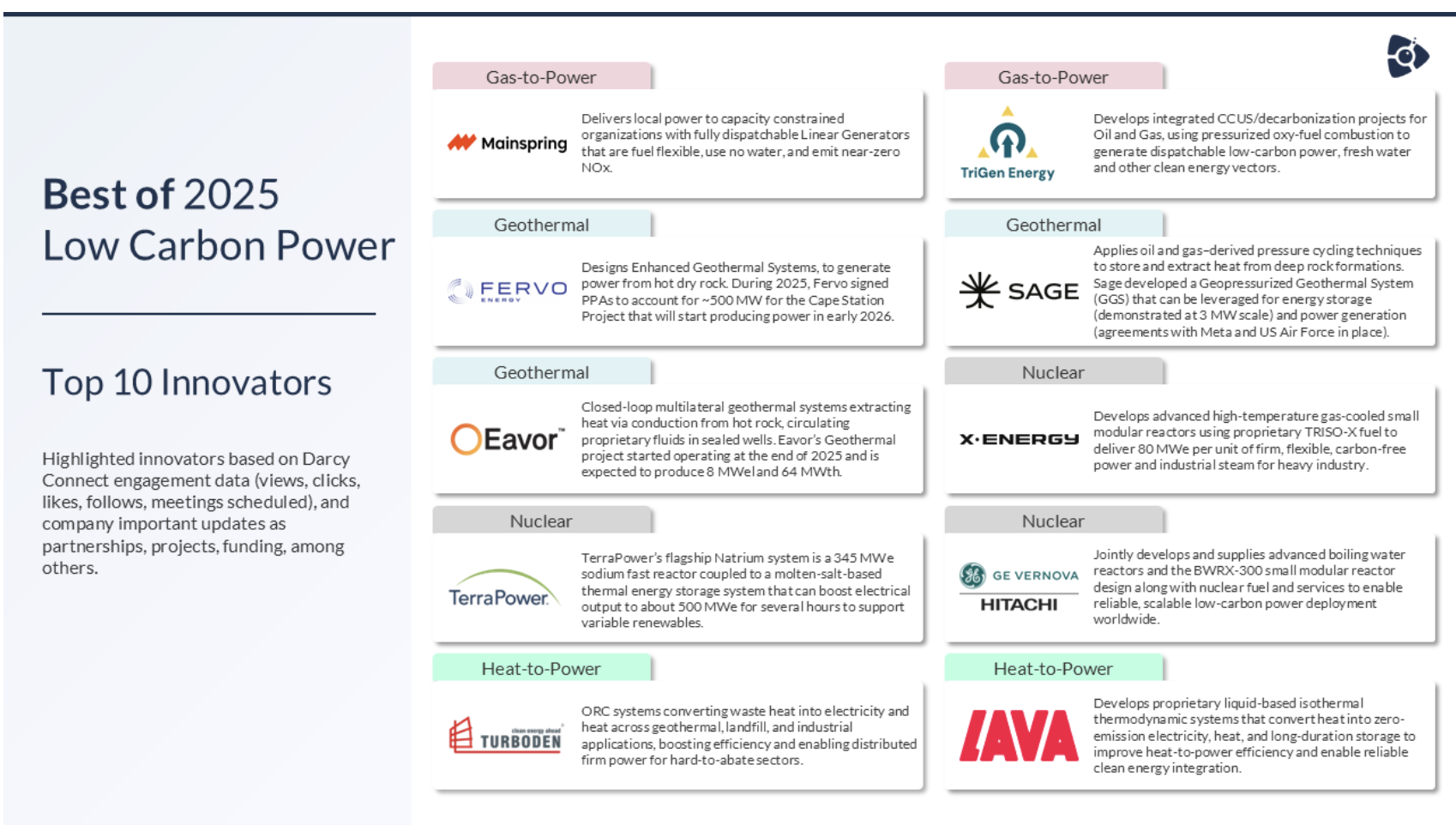
Gas-to-Power
-
Mainspring Energy - The linear generator developer shifted into high-volume execution in late 2025, supported by a $258m Series F round and an $87m Department of Energy grant to construct a flagship manufacturing facility in Pennsylvania. Mainspring is positioned as a primary solution for AI data centers and utilities looking to bypass multi-year interconnection queues while adhering to carbon-reduction mandates.
-
TriGen Energy - Specialized for oilfield decarbonization through oxy-combustion power generation using low quality gas and reusing the captured carbon for EOR purposes, this company is focused on adding value to brownfields. It is not restricted to this working field and can be used as an integrator of power generation and CCUS.
Geothermal Energy
-
Fervo Energy - The EGS-based geothermal company entered a swift execution phase in late 2025, marked by a $462m Series E round and the start of commercial operations at its flagship 400 MW Cape Station in Utah. Backed by strategic partnerships with Google, Amazon, and Mitsubishi and having recently filed for a 2026 IPO, Fervo is now one of the primary movers in the clean-firm energy market.
-
Eavor Technologies - The closed-loop geothermal energy developer delivered the world’s first electrons from a closed-loop system to the German grid at its Geretsried facility, which also demonstrated a 50% reduction in drilling time through iterative technical gains. Supported by a ~$100m commitment from the Canada Growth Fund in mid-2025 and strategic backing from OMV, bp Ventures and Microsoft Climate, Eavor enters 2026 with a robust multi-gigawatt pipeline.
-
Sage Geosystems - The geothermal systems developer reached a commercial inflection point in late 2025 with the successful testing of its Christine facility in Texas and a strategic agreement with Ormat Technologies to retrofit existing geothermal plants with Sage’s high-pressure deep-drilling techniques. Backed by an oversubscribed $97m Series B round co-led by Ormat and Carbon Direct, and a landmark 150 MW supply agreement with Meta.
Nuclear Power
-
X-Energy - The advanced nuclear company transitioned into full-scale execution in late 2025, highlighted by the U.S. Nuclear Regulatory Commission accepting its construction permit for the Dow Seadrift project in Texas and the commencement of vertical construction at its Tennessee fuel fabrication facility. Commercially, X-energy de-risked its 11 GW pipeline through a $700m Series D financing round and a multi-gigawatt deployment partnership with Amazon and Energy Northwest, establishing the company as a key vertically integrated provider for the next generation of AI data centers and chemical manufacturing.
-
TerraPower - The sodium-cooled reactor manufacturer secured $650m fundraise led by NVIDIA’s NVentures and achieved a major regulatory milestone with the NRC’s first-ever final environmental impact statement for an advanced commercial reactor. Strengthened by a massive agreement with Meta for up to eight reactors (~3 GW) and ongoing construction at its flagship Wyoming site.
-
GE Vernova Hitachi Nuclear Energy - The small modular boiling water reactor developer entered a major execution phase in 2025, highlighted by Ontario’s approval to begin full-scale construction on the first of four units at the Darlington site. They also landed the quickest-ever completion of the design assessment of UK’s nuclear regulatory approval, and they successfully secured of a $400m DOE grant to accelerate TVA’s Clinch River project.
Heat-to-Power
-
Turboden - The ORC system developer successfully commissioned of North America’s first waste-heat-to-power project in a SAGD oil sands facility for Strathcona Resources and was backed as the core technology provider for Fervo Energy’s Cape Station and by a partnership with Vulcan Energy for carbon-neutral lithium production in Europe.
-
LAVA Power - The isothermal thermodynamic cycle was backed by strategic venture capital and partnerships with firms like Orbia as it enters 2026 as a primary technology provider for industrial decarbonization, offering a modular, low-CAPEX solution.
Frequently Asked Questions
Who are the top low carbon power innovators in 2025?
According to Darcy Partners' 2025 Low Carbon Power Innovators list, leading companies include Mainspring Energy and TriGen Energy (gas-to-power), Fervo Energy, Eavor Technologies and Sage Geosystems (geothermal), X-energy, TerraPower and GE Vernova Hitachi Nuclear Energy (nuclear power) and Turboden and LAVA Power (heat-to-power). These innovators were selected based on technology progress, commercial traction, major project developments and engagement from more than 10,000 energy professionals on the Darcy Connect platform.
What low carbon power technologies are gaining the most momentum?
Several low carbon power technologies gained significant traction in 2025, including advanced nuclear reactors, enhanced geothermal systems (EGS), closed-loop geothermal systems, low-carbon gas-to-power solutions and waste heat-to-power technologies. Growing electricity demand from AI infrastructure, data centers and industrial electrification has increased interest in reliable, scalable sources of clean power. The next frontier is set to be fast deployment and grid integration of these technologies.
What is clean firm power and why is it important?
Clean firm power refers to low-carbon electricity sources that can provide reliable power whenever it is needed, regardless of weather conditions. As electricity demand continues to grow, utilities, industrial facilities and data center operators are increasingly seeking clean firm power solutions that can support grid reliability while helping meet decarbonization goals and contributing to energy security.
Why are geothermal and advanced nuclear attracting so much attention?
Geothermal and advanced nuclear technologies are gaining momentum because they offer the potential to provide continuous, low-carbon electricity at utility-scale. Companies such as Fervo Energy, Eavor Technologies, Sage Geosystems, TerraPower and X-energy are advancing projects that demonstrate how these technologies can support growing power demand while improving energy security and grid reliability.
