


There’s no shortage of lists to summarize the past year. But here at Darcy, we have a unique data set driven by activity on Darcy Connect from over 10,000 energy professional Connect Users. Our data highlights which innovators gained the most attention through storefront views, clicks, follows, meetings scheduled and direct operator engagement. Combined with analysis from our Research Team on technology maturity and market traction, we’ve selected the Top 10 Innovators of 2025 across our coverage channels. This is our way of saying: "these are the innovators your peers are paying attention to and the ones worth learning more about".
In this article, you will find the Innovators that made it on the list in the category of Subsurface.
The Top 10 Darcy Innovators of 2025 in Subsurface
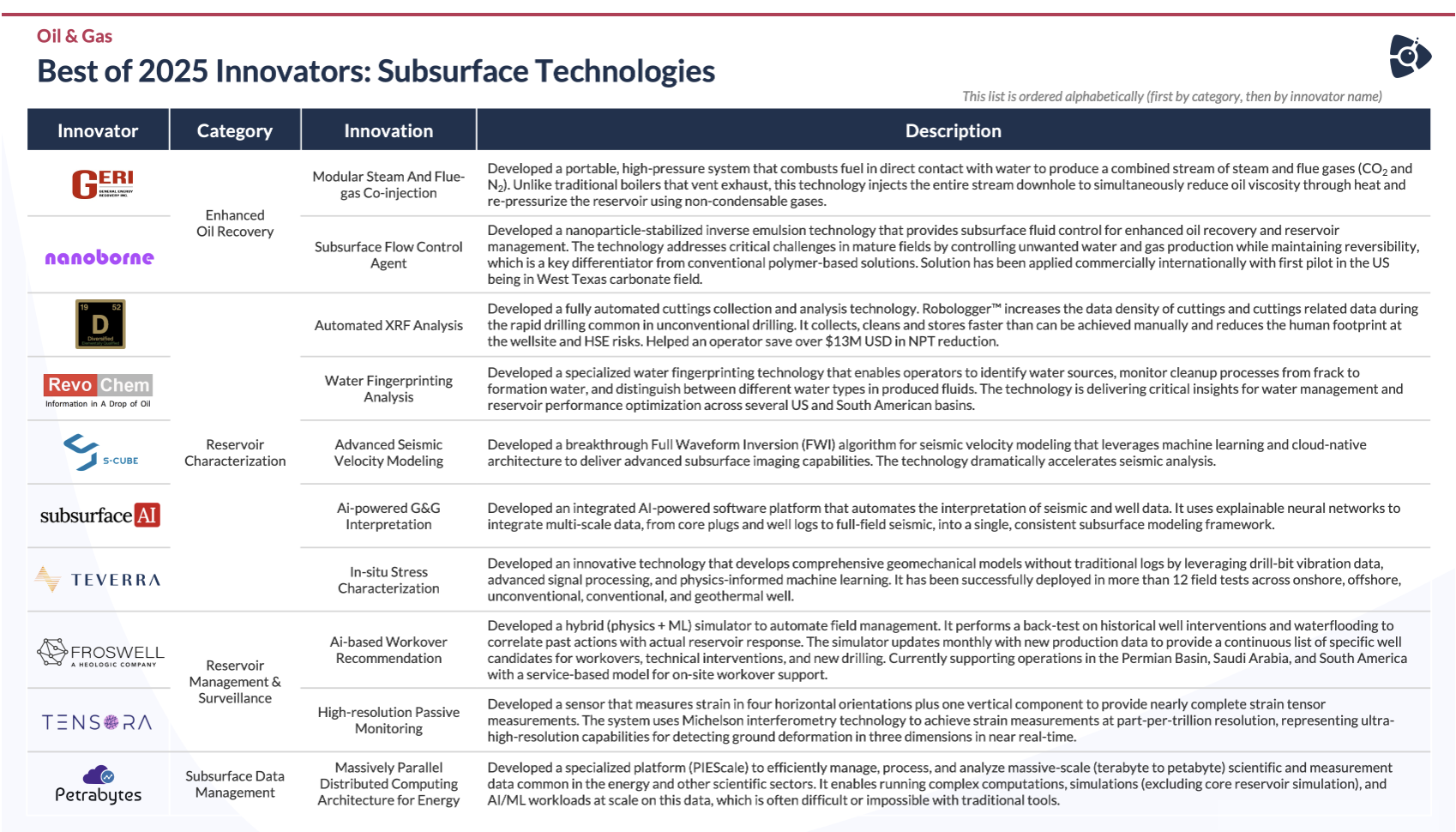
Enhanced Oil Recovery
Modular Steam and Flue-gas Co-injection
-
GERI - Developed a portable, high-pressure system that combusts fuel in direct contact with water to produce a combined stream of steam and flue gases (CO2 and N2). Unlike traditional boilers that vent exhaust, this technology injects the entire stream downhole to simultaneously reduce oil viscosity through heat and re-pressurize the reservoir using non-condensable gases.
Subsurface Flow Control Agent
-
Nanoborne - Developed a nanoparticle-stabilized inverse emulsion technology that provides subsurface fluid control for enhanced oil recovery and reservoir management. The technology addresses critical challenges in mature fields by controlling unwanted water and gas production while maintaining reversibility, which is a key differentiator from conventional polymer-based solutions. Solution has been applied commercially internationally with first pilot in the US being in West Texas carbonate field.
Reservoir Characterization
Automated XRF Analysis
-
Diversified Well Logging - Developed a fully automated cuttings collection and analysis technology. Robologger™ increases the data density of cuttings and cuttings related data during the rapid drilling common in unconventional drilling. It collects, cleans and stores faster than can be achieved manually and reduces the human footprint at the wellsite and HSE risks. Helped an operator save over $13M USD in NPT reduction
Water fingerprinting Analysis
-
Revochem - Developed a specialized water fingerprinting technology that enables operators to identify water sources, monitor cleanup processes from frack to formation water and distinguish between different water types in produced fluids. The technology is delivering critical insights for water management and reservoir performance optimization across several US and South American basins.
Advanced Seismic Velocity Modeling
-
S-Cube - Developed a breakthrough Full Waveform Inversion (FWI) algorithm for seismic velocity modeling that leverages machine learning and cloud-native architecture to deliver advanced subsurface imaging capabilities. The technology dramatically accelerates seismic analysis workflows and has been deployed globally by companies like Shell, Chevron and Petrobras.
AI-powered G&G Interpretation
-
SubsurfaceAI - Developed an integrated AI-powered software platform that automates the interpretation of seismic and well data. It uses explainable neural networks to integrate multi-scale data, from core plugs and well logs to full-field seismic, into a single, consistent subsurface modeling framework.
In-situ Stress Characterization
-
Teverra - Developed an innovative technology that develops comprehensive geomechanical models without traditional logs by leveraging drill-bit vibration data, advanced signal processing, and physics-informed machine learning. It has been successfully deployed in more than 12 field tests across onshore, offshore, unconventional, conventional and geothermal well.
Reservoir Management & Surveillance
AI-based Workover Recommendation
-
Froswell - Developed a hybrid (physics + ML) simulator to automate field management. It performs a back-test on historical well interventions and waterflooding to correlate past actions with actual reservoir response. The simulator updates monthly with new production data to provide a continuous list of specific well candidates for workovers, technical interventions, and new drilling. Currently supporting operations in the Permian Basin, Saudi Arabia and South America with a service-based model for on-site workover support.
High-resolution Passive Monitoring
-
Tensora - Developed a sensor that measures strain in four horizontal orientations plus one vertical component to provide nearly complete strain tensor measurements. The system uses Michelson interferometry technology to achieve strain measurements at part-per-trillion resolution, representing ultra-high resolution capabilities for detecting ground deformation in three dimensions in near real-time.
Subsurface Data Management
Massive Parallel Architecture
-
Petrabytes - Developed a specialized platform (PiScale) to efficiently manage, process, and analyze massive-scale (terabyte to petabyte) scientific and measurement data common in the energy and other scientific sectors. It enables running complex computations, simulations (excluding core reservoir simulation) and AI/ML workloads at scale on this data, which is often difficult or impossible with traditional tools.
Frequently Asked Questions
Who are the top subsurface innovators in 2025?
According to Darcy Partners' 2025 Subsurface Innovators list, leading innovators include GERI, Nanoborne, Diversified Well Logging, Revochem, S-Cube, SubsurfaceAI, Teverra, Froswell, Tensora and Petrabytes. These companies were selected based on technology innovation, market traction, operator engagement and activity across the Darcy Connect platform.
What technologies are transforming subsurface characterization and reservoir management?
Several technologies are reshaping subsurface workflows, including AI-powered geological interpretation, advanced seismic imaging, automated cuttings analysis, water fingerprinting, geomechanical modeling and large-scale subsurface data management platforms. These innovations help operators improve decision-making, reduce uncertainty and optimize reservoir performance.
How is artificial intelligence being used in subsurface analysis?
Artificial intelligence is increasingly being applied to automate the interpretation of seismic, geological and well data. Companies such as SubsurfaceAI, S-Cube, Teverra and Froswell are using machine learning, physics-informed models and advanced analytics to accelerate subsurface understanding, improve reservoir management and support more informed operational decisions.
What is reservoir characterization and why is it important?
Reservoir characterization is the process of understanding the geological, geophysical and fluid properties of a reservoir to support exploration, development and production decisions. Advanced technologies such as seismic imaging, geomechanical modeling, automated data collection and fluid analysis can improve reservoir characterization accuracy and reduce operational uncertainty.
How does Darcy Partners identify top innovators in subsurface technologies?
Darcy Partners combines engagement data from more than 10,000 energy professionals on the Darcy Connect platform with independent research on technology maturity and market traction. Selection factors include operator engagement, storefront activity, commercial deployments, technology adoption and the potential impact of the innovation on subsurface characterization, reservoir management and field development.
